













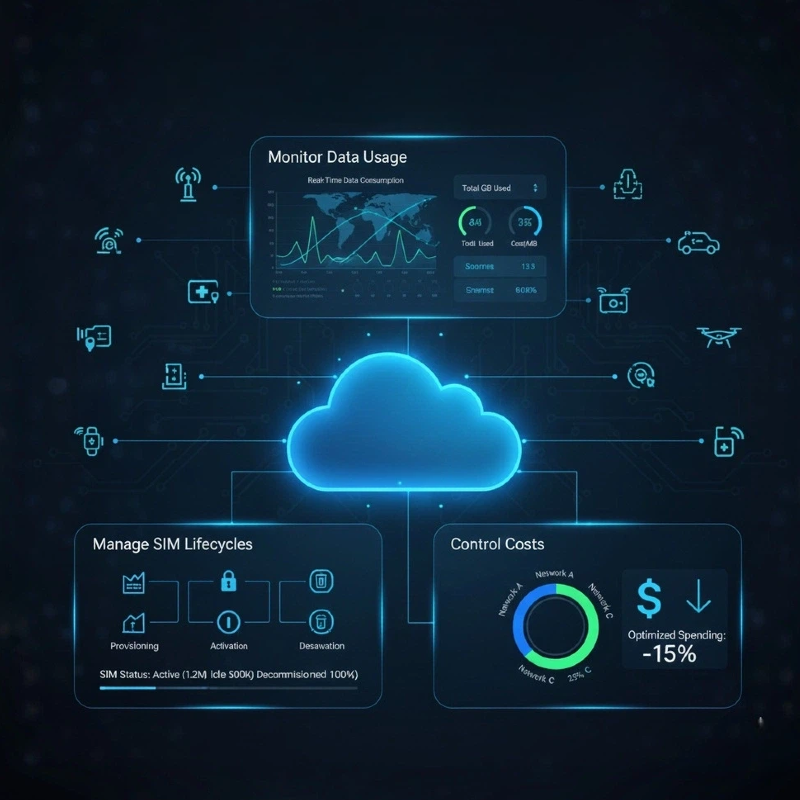








The rapid growth of IoT applications has changed how enterprises manage connected devices. From smart terminals to connected vehicles, companies need efficient methods to control eSIM profiles, network resources, and device communication throughout the product lifecycle.
Selecting the right platform requires attention to compatibility, integration, security, and operational management. For enterprises building large-scale IoT networks, an eSIM IoT manager can provide support for remote configuration and device connectivity management across different application environments.

Checking SGP.32 Compatibility and Platform Interoperability
The primary technical benchmark enterprises should evaluate is strict compliance with GSMA SGP.32 specifications. As the next-generation standard for IoT Remote SIM Provisioning (RSP), SGP.32 is designed for IoT RSP scenarios and differs from earlier M2M/consumer architectures, enabling server-driven, automated profile downloads and fleet management across lightweight IoT devices. Compatibility with eSIM specifications helps the platform communicate with remote provisioning components, devices, and operator systems during connectivity management.
A suitable platform should work with different device types and network environments. IoT projects often involve various hardware suppliers, communication operators, and service providers, so interoperability can influence deployment efficiency.
Enterprises should also check how the platform connects with the eSIM ecosystem. The interaction between eIM, eSIM profiles, operator resources, and device modules needs coordinated management to support stable operations.
An effective eSIM IoT manager should provide a structured approach for handling these relationships. This allows companies to manage different connected devices without creating separate processes for each deployment scenario.
Evaluating API Integration, Multi-Operator Support, and Batch Management
API capability is an important part of eSIM management platform selection. Enterprises should evaluate whether the platform can connect with existing systems, such as IoT management platforms, business applications, or internal operation tools.
Through API integration, companies can exchange device information, connectivity status, and management data between different systems. This reduces repeated manual operations and helps teams maintain clearer workflows — all coordinated through a centralized eSIM IoT remote manager.
Multi-operator support is also important for IoT projects that cover different regions. A single enterprise may cooperate with several operators because of geographic coverage, service requirements, or project conditions. An eSIM IoT remote manager simplifies multi-carrier orchestration by consolidating network resources into a unified interface.
The ability to manage multiple network resources from one platform improves daily operation efficiency. With it, enterprises can handle device groups, profile updates, activation tasks, and connection status management through centralized operations, reducing operational overhead and enabling more efficient response to connectivity issues.
Reviewing Security, Scalability, and Operation Efficiency
Security management is a key consideration when enterprises choose an eIM platform. Companies should review how the platform protects device information, controls user permissions, and manages access to different functions.
Permission management is especially useful for organizations with multiple teams. Technical departments, operation teams, and service personnel may require different access levels according to their responsibilities.
Scalability should also be considered during platform evaluation. IoT projects may expand over time, increasing the number of connected devices and changing management requirements. A suitable system should support these changes without creating unnecessary complexity.
Monitoring and alert functions can also improve long-term operation. By checking device status, connection conditions, and potential issues, enterprises can identify problems earlier and improve maintenance processes.
With experience in secure identity and connection technologies, BHDC supports business customers that require reliable management capabilities for connected applications. BHDC’s technical foundation encompasses smart card OS (COS) architecture, Secure Element (SE) integration, and enterprise IoT connectivity platforms.
Platform Selection Checklist and BHDC eIM Platform Capabilities
Before selecting an eIM platform, enterprises should create a practical evaluation checklist. Important points include SGP.32 compatibility, ecosystem interoperability, API connection ability, operator support, security functions, scalability, and monitoring features.
Different industries may focus on different requirements. Operators may need flexible subscriber and network resource management. Automotive companies may require stable connectivity support for connected vehicles. OEM companies may need solutions that match different product platforms.
IoT device companies often require centralized management because large numbers of terminals may be deployed in different locations. In these situations, the platform should support remote configuration, device grouping, and operational monitoring.
BHDC provides eIM platform capabilities for enterprise IoT deployment. Our solution focuses on eSIM management, remote configuration, and connectivity coordination for different business scenarios.
The platform supports customers that need to manage connected devices at scale. Through centralized operations, enterprises can organize device information, manage connectivity resources, and improve the efficiency of IoT deployment processes.
A professional eSIM IoT manager should not only provide basic management functions but also support future business expansion. Enterprises need to consider platform flexibility, technical support, and long-term operation requirements before making a decision.
Building Better IoT Connectivity Management for Future Applications
An eSIM platform plays an important role in how enterprises manage connected products and digital services. Companies need to evaluate factors such as compatibility, integration capability, security management, and operational efficiency when building and maintaining IoT networks.
With the growing diversity of devices, operators, and deployment environments, businesses need platforms that can adapt across all three dimensions. The right management approach helps enterprises organize connectivity resources more effectively.
Through experience in identity authentication and connection technologies, BHDC serves customers in telecommunications, automotive, finance, and IoT-related fields. We focus on providing practical solutions for enterprise connectivity management.
With an eSIM IoT manager, companies can improve device lifecycle management and support wider IoT applications. A suitable one provides a foundation for organized connectivity operations and future digital development.